Emergency rescue
The car is equipped with the mandatory emergency call system, which is active by default. The emergency call system handles two types of SOS calls in the EU:
| • | Automatic SOS calls |
| • | Manual SOS calls |
When an airbag or emergency impact sensor is triggered, the car automatically calls an emergency rescue service so that the occupants can speak with an emergency service operator. This function is only activated automatically if the vehicle is involved in a traffic accident where an airbag and/or the seat belt systems have been activated.
When an SOS call is activated, the car calls the emergency rescue service to allow the driver and the passengers to speak to an emergency service operator. The car also automatically sends a restricted set of data to help the emergency service assess the situation.
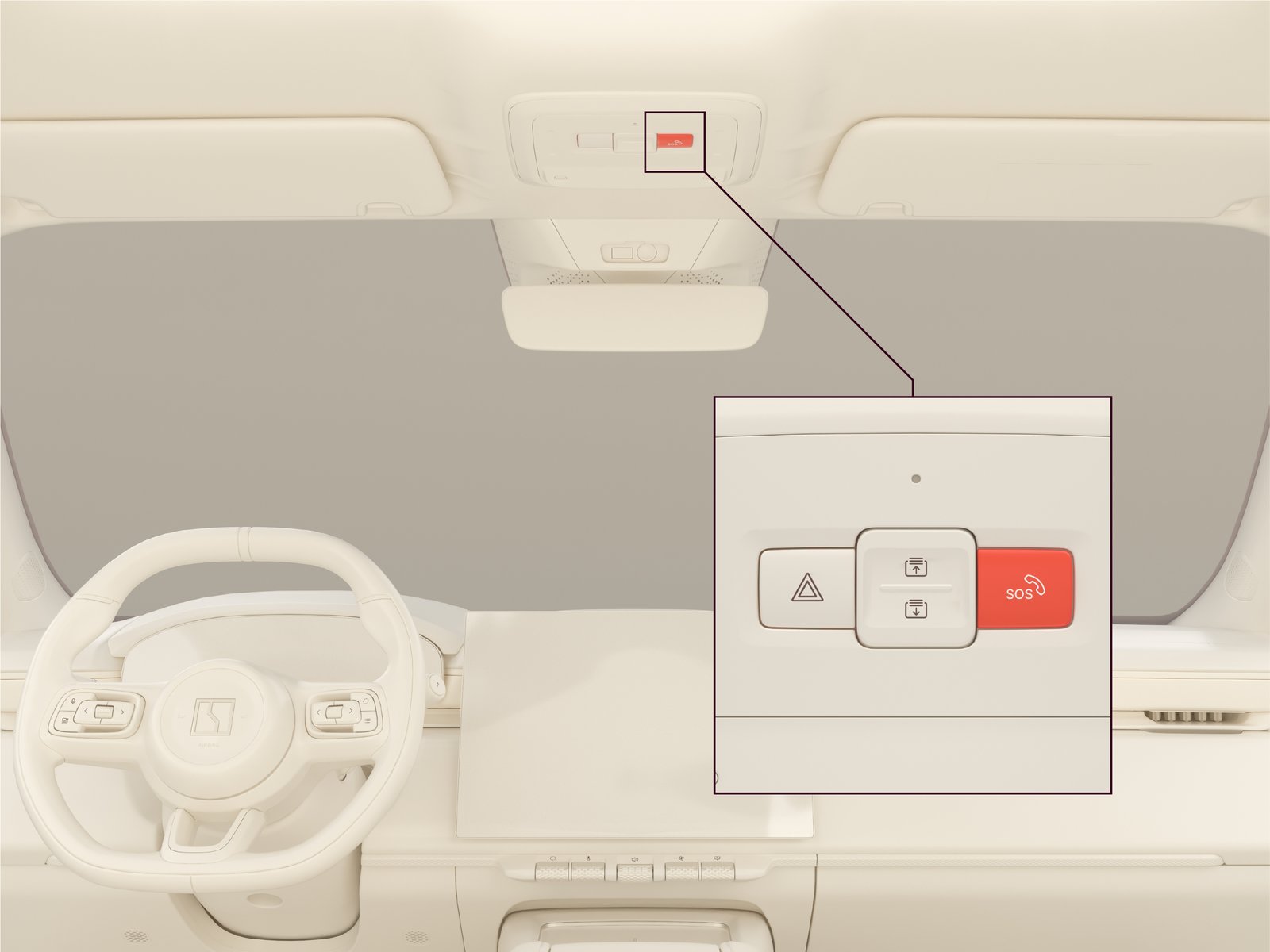
To make a manual emergency call, press and hold the manual SOS call button in the overhead console for 2–8 seconds.
Note: Touching the SOS call button for fewer than 2 seconds, or more than 8 seconds, does not activate the call function.
Note: The manual SOS call button is only intended for use in an emergency such as an accident, illness, or a threat against the car and the passengers.
Note: The emergency rescue systems will not work if no mobile network is available or if the vehicle cannot supply power to the emergency rescue functions. If the SOS service is unavailable, a voice message is emitted. If the mobile network is unavailable, a message appears on the center display.
SOS emergency call
Information sent
During an SOS call the car automatically sends a minimum set of data, such as the exact location of the car, the time of the call, the vehicle identification number (VIN) of the car, number of seated occupants, and the travel direction. The recipients of data that is processed during such emergency SOS call are exclusively the relevant emergency call inquiry terminals. This information is only sent to help the emergency services assess the situation. The processing of such data is mandatory pursuant to Regulation (EU) 2015/758 and latest amendments.
Note: No tracking (registering of the position of your car or monitoring of your driving) or transmission of data is made during normal use of the car. The vehicle location data is constantly overwritten in the internal memory of the car.
Storage and processing
When the emergency call system is used to make an SOS call, your data is processed according to the EU data protection rules. Your data is stored no longer than 13 hours, but usually less time, by the emergency call center. All data is removed when no longer required. All storage and processing of personal data is subject to the EU data protection and online privacy.
EU data protection and online privacy
Any processing of personal data through the emergency call system complies with the personal data protection rules regulation (EU) 2016/679 and directive 2002/58/EC.
More information about the EU data protection and online privacy can be found at: https://europa.eu/youreurope/citizens/consumers/internet-telecoms/data-protection-online-privacy/index_en.htm.